The numbers
What this guide replaces
The numbers first, the reasoning after. The largest item is not in the table – it is underneath it.
See the breakdown – item by item
| What it involves | The usual way | Here |
|---|---|---|
| An initial call to establish the situation | 1 to 2 hours per prospect | avoided for those who are not ready yet |
| A website analysis as a consulting service | €400 – 1,200 per analysis | self-service, immediate result |
| Building the question logic and evaluation | €8,000 – 18,000 once | built in house |
| Running and maintaining the answer library | €200 – 600 per month | in house, in the editorial system |
| First year, at two analyses a month | €20,000 – 54,000 | part of running the website |
Where these figures come from: Typical market rates for the German Mittelstand, deliberately set at the lower end – not quotes obtained for this purpose. Anyone paying more will find the gap larger, not smaller.
The real benefit is the pre-qualification. Every initial call that does not happen – because the prospect worked out for themselves that it is too early – saves two hours on both sides. Nobody puts that in a calculation, and it is the largest item.
Starting point
Why not a chatbot
The obvious answer to “prospects have questions” is a language model on the website. That is convenient – and risky for a consulting business.
Three reasons for governed answers
- An open model promises things nobody has checked. On a consulting site every statement is a statement by the company. Handing that to a freely phrasing model means giving up control of your own offering.
- Prospects do not want a conversation, they want orientation. The question is almost never “tell me about AI” but “is this worth it for me?”. A guided route answers that better than an empty input box.
- An empty input box is a barrier. People who do not know what to ask, ask nothing. Offering starting points lowers the threshold noticeably.
So the decision went to checked answer blocks rather than open live AI – a deliberate limitation that raises the usefulness instead of lowering it.
In service
Two routes to an answer
One measures something measurable, the other sorts out something unclear. Both end in the same place: a result the prospect can work with on their own.
The website check: what can be measured
Load time, stability, clarity, SEO basics and the technical setup. The result is not an impression but a value – verifiable with independent tools. Poor scores make the point immediately; good scores are evidence.
The compass: what is unclear
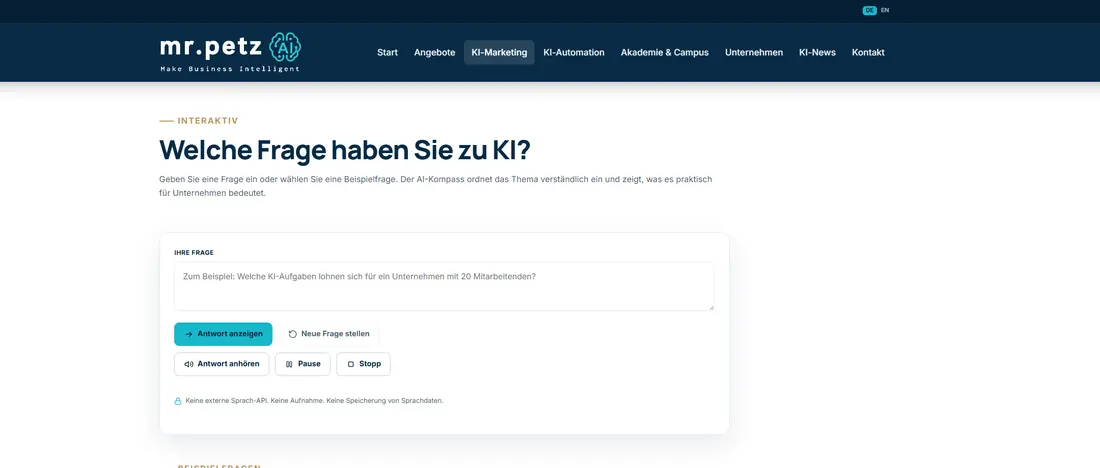
Six areas of knowledge, a guided route from question to orientation. Instead of an empty box there are starting points to choose from. The answers come from checked blocks, not from a model phrasing freely.
What comes out at the end
A result the prospect can take away – not a form they have to fill in to get it. The difference sounds small and decides whether the tool is read as help or as a trap. Anyone who calls afterwards calls because they know something, not because they had to hand something over.
How it is built
The decisions behind it
For a tool prospects operate directly, everything comes down to two questions: what may it say, and what happens to the input.
- Checked blocks rather than free phrasing. Every answer was written once and checked once. That is more work than plugging in a model, and it is the only way to know what your own website says.
- No data without consent. The check runs without anything having to be entered first. Anyone who wants to get in touch afterwards does so deliberately.
- Read-aloud without an external service. The speech output runs in the reader's browser. No audio leaves the page, nothing is stored – and there are no per-call costs.
- The content lives in the editorial system. Answer blocks are text, not code. They are maintained where the rest of the content is – otherwise nobody maintains them.
What it means
What this is worth to a company
Almost every company is currently weighing up whether to put an AI assistant on its website. The more interesting question is which kind.
- I know the trade-off from having made it. Open model versus checked blocks is not a technical question but one of liability and brand. Answer it technically and you answer it wrongly.
- Pre-qualification is sales work, not a marketing gimmick. A tool that politely filters out unsuitable enquiries is worth more than one that raises the enquiry count.
- Data protection as a design requirement. That no voice data leaves the page is not an accident but a decision taken before the first line of code. It cannot be retrofitted.
The business check is deliberately the dullest of the seven systems. It can do less than a language model and in exchange it says nothing wrong. In a company that is liable for its statements, that is the right order of priorities.
Take it with you
This reference as a PDF
The figures, the build and the reasoning, laid out for A4 – without navigation, with contact details in the footer.