The numbers
What the funnel has produced – and what it replaces
The numbers first, the reasoning after. The result figures are today's state, not an extrapolation.
See the breakdown – item by item
| What it involves | Bought in | Here |
|---|---|---|
| Address research and enrichment, 6,718 companies | €2 – 8 per record – €13,000 to 52,000 | automated, 25 companies per run |
| A tool to work and segment the list | €12,000 – 25,000 to build | built in house |
| Appointment setting, four meetings so far | €150 – 400 per qualified meeting | part of the same process |
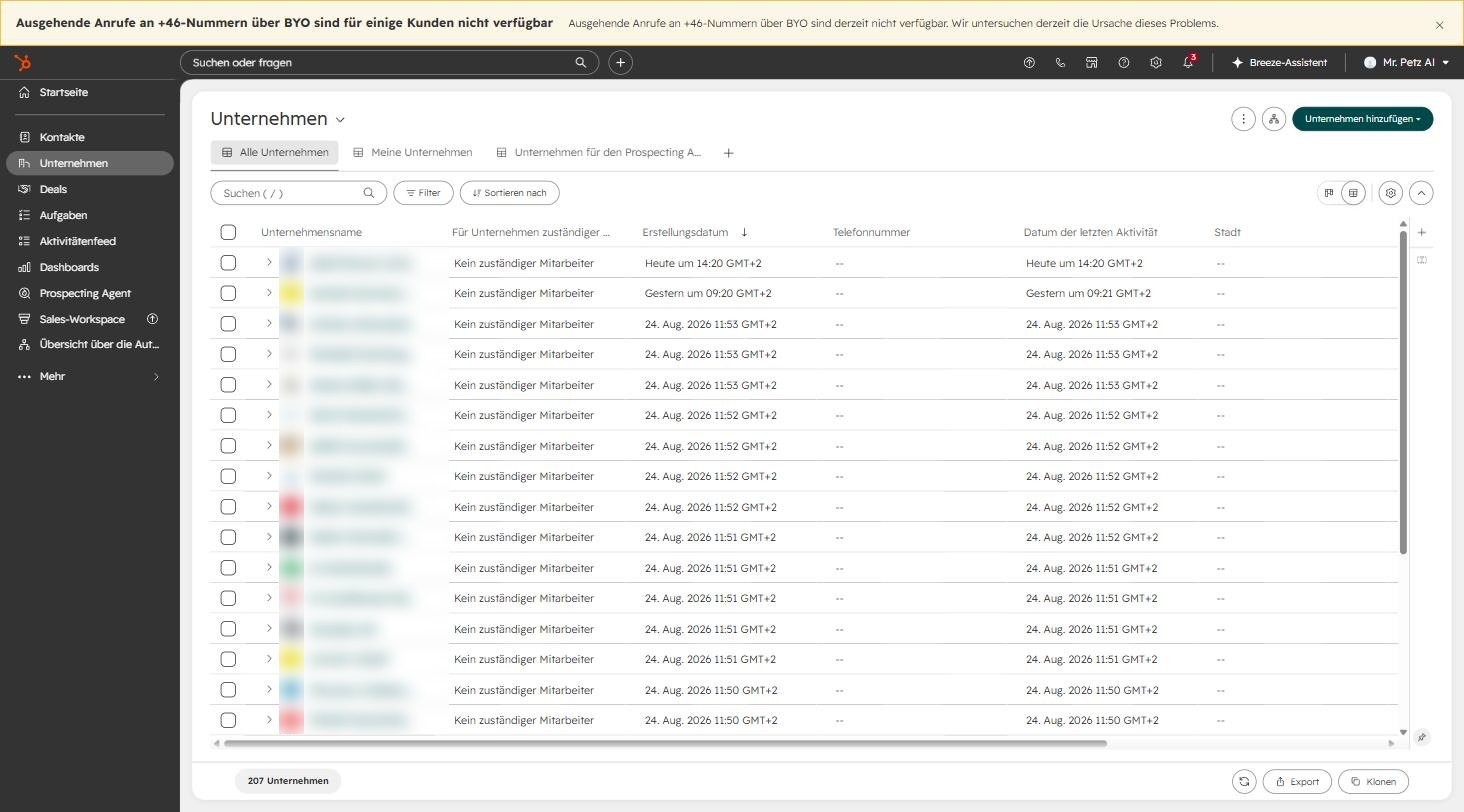
| Transfer into the CRM | hourly rate per import | automated, as non-marketing contacts |
| Ongoing management by a supplier | €1,500 – 4,000 per month | none |
| Order of magnitude, first year | €43,000 – 125,000 | server costs and own time |
Where these figures come from: List prices from German B2B address and appointment-setting providers, deliberately set at the lower end – not quotes obtained for this purpose.
How the result figures are counted: All values are the state of the cockpit on 27 August 2026 and can be recounted there. The funnel has been running since 13 August – with pauses, alongside the day job. Outreach goes out in small batches with a daily cap of 50 letters rather than one large wave; the largest so far was 73 on 22 August. There is deliberately no response rate here: over two weeks that would be a snapshot, not a metric.
And what the numbers do not say: 26 replies and four meetings in two weeks are a start, not a success story. The funnel runs, it delivers, and it delivers traceably – that is the point. Anyone showing large numbers at this stage has usually extrapolated them.
Starting point
Why build a cockpit
New business in the Mittelstand rarely fails on the idea and almost always on stamina. Working through 6,000 companies does not take sales talent – it takes a tool that keeps the overview.
What a CRM alone does not do
- A CRM manages contacts, it does not run a working day. No contact list answers the question “who do I call today, and why this one?”. That is exactly what the cockpit is built for.
- Research is the actual work. Without the industry, the size, a named contact and a reason to call, an address is worthless. Doing that enrichment by hand across 6,718 records is not a question of discipline but of processing time.
- Without a brake, automation gets dangerous. A system that sends emails on its own turns one segmentation error into a thousand burnt contacts. Nothing goes out here without an explicit release.
In service
What a working day looks like in it
The cockpit answers three questions: what is due today, what is ready to send, what is on follow-up. Everything else is secondary.
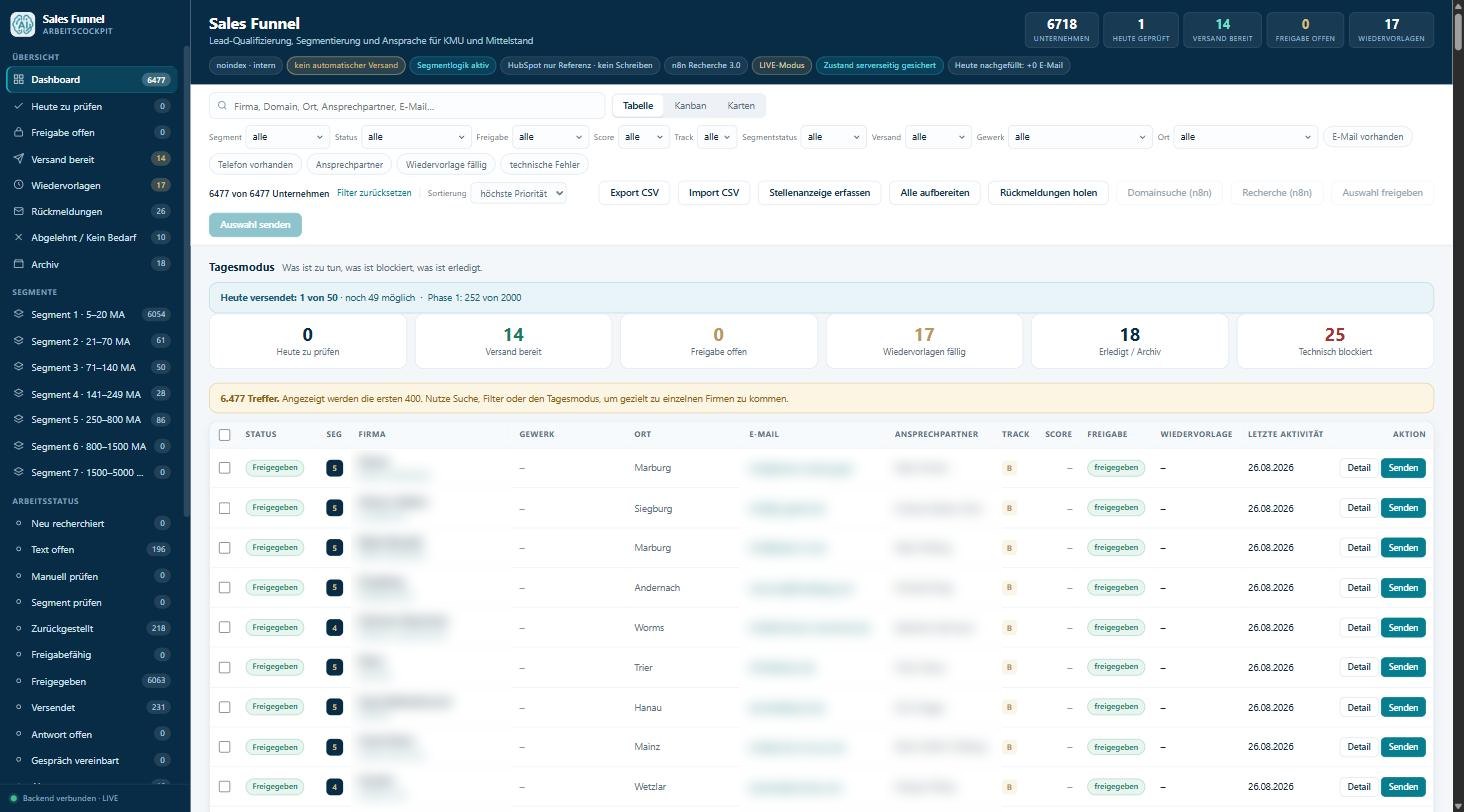
A daily mode, not an endless list
Not 6,718 rows but the amount that can be done in a day. Show someone an infinite list and they never start.
Segmented by reason
Industry and size are the coarse grid. What matters is the reason: what about this company justifies getting in touch? Without an answer, the record stays where it is.
Approval as its own step
Research is automatic, the decision is manual. Between “prepared” and “sent” there is always a person. That is inconvenient, and it is why nothing embarrassing goes out.
Follow-ups with a memory
Who said what and when sits on the record. A reasoned no is worth more than an unanswered attempt – and stops the same contact getting the same letter six months later.
Where the data comes from
The research does not run in the cockpit but in a separate automation on a server of its own. It works in runs of 25 companies, checks each source individually and produces a file the cockpit reads in. Every step can be repeated – which matters, because websites are unreliable and an aborted run would otherwise discard everything.

How it is built
The decisions behind it
With sales systems, quality is decided not by the feature list but by what they deliberately do not do.
- The automation researches and prepares. It sends nothing. That separation is not a technical limitation but the condition for a company being allowed to run such a system at all.
- The logic lives in one place. All rules sit in the automation, not additionally in the CRM. Two systems with their own rules produce two versions of the truth, and in six months nobody knows which one applies.
- Contacts are not held as marketing contacts to begin with. That is a commercial decision: records are free up to a million, marketing contacts cost money from a thousand. They are converted individually, only when outreach is actually due.
- Credentials do not sit on the web server. All keys live only in the automation environment. If the website is compromised, the sales base is not.
What it means
What this is worth to a company
The funnel was built for one sales operation. What makes it transferable is not the software but the thinking behind it.
- I know what a lead costs – because I know both routes. Bought in and generated in house. Faced with a quote from a lead agency, I can tell effort from margin.
- Automation with a brake can be sold internally; without one it cannot. Sales directors say no to fully automatic outreach for good reason. A system with an approval step gets the sign-off it needs.
- A commercial eye on the tooling. Choosing non-marketing contacts has nothing to do with technology and saves a four-figure sum a year. Nobody who only reads the feature list spots that.
Sales systems do not fail on technology. They fail because nobody wants to use them on a Tuesday afternoon. This cockpit is built around that one question – which is why it is still running.
Take it with you
This reference as a PDF
The figures, the build and the reasoning, laid out for A4 – without navigation, with contact details in the footer.