The numbers
What these flows replace
The numbers first, the reasoning after. With automation the expensive item is rarely the build.
See the breakdown – item by item
| What falls due in a year | With a supplier | Here |
|---|---|---|
| Building the flows, once | €10,000 – 20,000 | built in house |
| Ongoing management and changes | €1,500 – 4,000 per month | none |
| Licence for the automation platform | €50 – 500 per month depending on model | none – open base version on own server |
| CRM licence at the tier the setup would need | €800 – 3,600 per month on a higher tier | entry tier is enough, because the logic sits outside |
| A new flow, say an extra research source | €800 – 2,500 per request | in house, one to two hours |
| Server | included in the package | around €20 per month |
| Running cost per year | €18,000 – 48,000 | around €240 plus model calls |
Where these figures come from: Typical market rates for the German Mittelstand, deliberately set at the lower end – not quotes obtained for this purpose. Anyone paying more will find the gap larger, not smaller.
The largest single item is invisible. The CRM entry tier is only sufficient because all the logic lives in the automation rather than in the CRM. Mapped there, the next tier up would be required – that alone is a four-figure decision per month.
Starting point
Why run it on your own server
Automation is usually treated as a choice of tool. It is a question of architecture: where does the logic live, who owns the data, and what happens when a vendor changes its pricing.
Three decisions you only make once
- Own server rather than a subscription. Automation services bill per run. Precisely when a flow proves its worth and runs more often, it gets expensive. On your own server the thousandth run costs the same as the first.
- The logic belongs in one place. The obvious temptation is to keep a few rules in the CRM and a few in the automation. Six months later nobody knows which one applies – and nobody dares change either.
- Research yes, sending no. The automation prepares and writes nothing into the CRM without a release. That separation is why this could be introduced in a company at all.
In service
What runs here
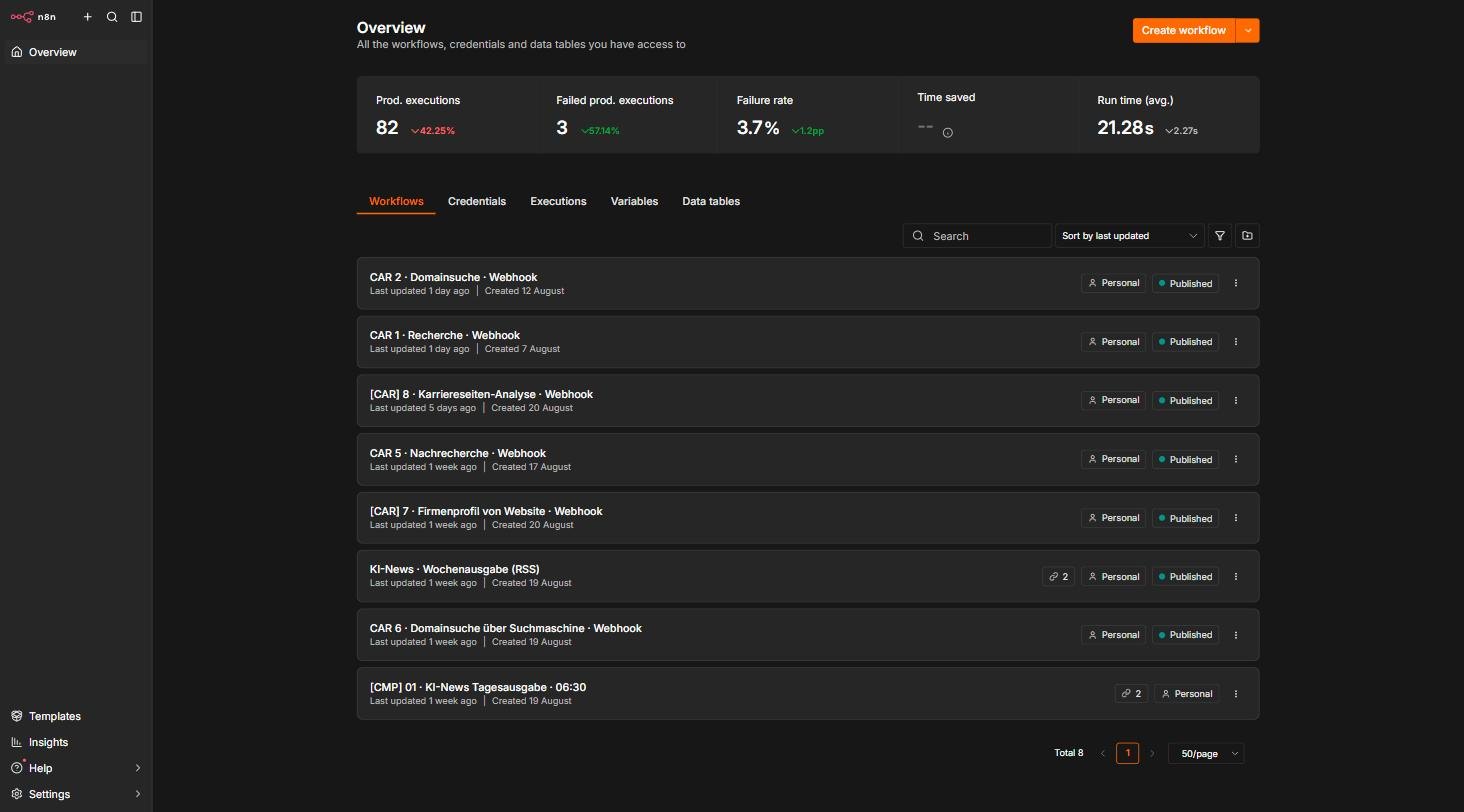
The automation is the connective tissue between the other systems. It researches for sales, produces the paper's daily edition and keeps the CRM up to date.
Research for sales
Find companies, enrich them, verify them. 25 records per run, every step repeatable on its own – which matters, because websites are unreliable.
The paper's daily edition
Source sweep, editorial pass, two review passes, release. Daily at 06:30, without anyone intervening.
CRM upkeep
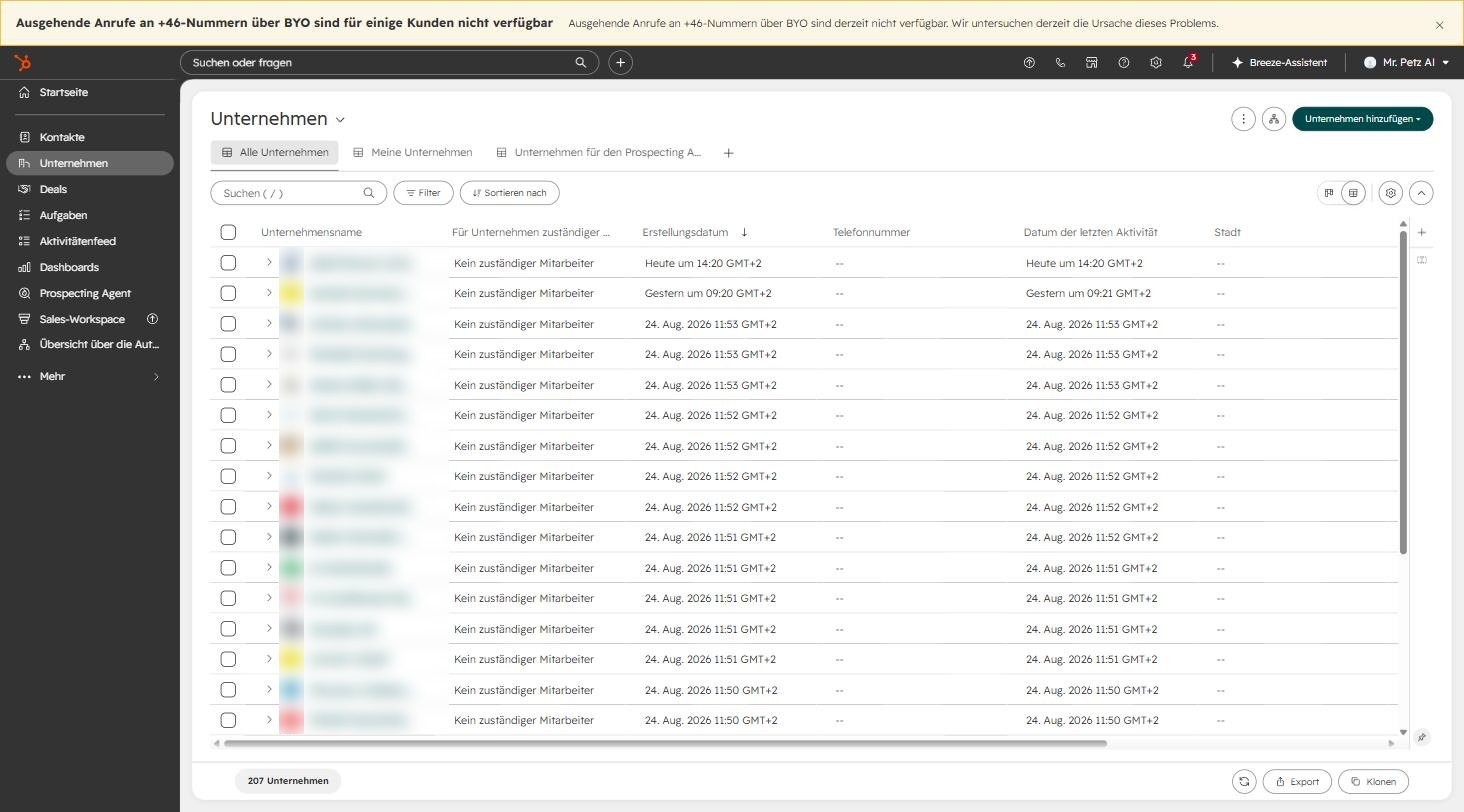
Import, matching and updating of records. Custom fields carry a fixed prefix so they stay distinguishable from standard ones.
Social media publishing
Prepared: the editorial system makes released posts available, the automation collects them and reports the outcome and figures back.
How the systems talk to each other
No system calls another uninvited. The editorial system makes things available, the automation collects them. The cockpit submits jobs and waits for an answer. That direction is deliberate: a system that gets pushed at has to be reachable at all times. A system that gets collected from may stand still for a while without anything being lost.
Operating rules
The rules that keep it manageable
Automation without operating rules becomes unmanageable by the third flow. These are written down before a new one gets built.
- No credentials inside the flow. Keys and passwords live only in the platform's secure store, never in a flow and never in code. An exported flow therefore contains nothing confidential.
- A fixed naming scheme. Every flow carries its area, number, purpose and trigger in the name. With three flows that seems excessive; with thirty it is the difference between order and searching.
- Contacts without marketing status to begin with. Records are free up to a million, marketing contacts cost money from a thousand. They are converted individually, only when outreach is due.
- Deleting is done by hand. The automation can create and change flows itself. Removing them, no. Orphaned flows get reported, not deleted.
What it means
What this is worth to a company
Automation projects rarely fail on technology. They fail on missing rules and on systems that contradict each other.
- I can raise the architecture question before the tool is chosen. Where does the logic live, who may write, what happens on failure. Ask those after go-live and you build twice.
- Licence cost is a consequence of architecture. That the CRM entry tier suffices here is not luck but the result of a deliberate decision. Only someone who knows both sides spots that connection.
- I know what a flow actually takes. Faced with a quote for an automation project, I can tell what takes two hours from what takes two weeks.
- Operating rules are the difference. Anyone can get something running once. Making sure it is still comprehensible a year later is the job.
The automation is the least visible of the seven systems – and the most important. It offers no interface to show off. Without it, the paper, the sales cockpit and the social planning would be three separate applications instead of one chain.
Take it with you
This reference as a PDF
The figures, the build and the reasoning, laid out for A4 – without navigation, with contact details in the footer.