The numbers
What a daily edition costs otherwise
The numbers first, the reasoning after. The interesting figure is not the build but the running cost.
See the breakdown – item by item
| What a daily edition costs | With an editorial supplier | Here |
|---|---|---|
| Scanning sources and choosing topics | 1 to 2 hours a day | automated, daily at 06:30 |
| Writing up around 19 stories | €60 – 200 per edition | automated, with two review passes |
| Translation into three further languages | €0.12 – 0.20 per word | part of the same run |
| Compiling the weekly newsletter | €150 – 400 per issue | from the same data |
| Building the portal and the pipeline | €8,000 – 15,000 once | built in house |
| Running cost per month | €1,800 – 6,000 | server costs and model calls |
Where these figures come from: Typical market rates for the German Mittelstand, deliberately set at the lower end – not quotes obtained for this purpose. Anyone paying more will find the gap larger, not smaller.
Why that is the interesting figure. Building a news site once is manageable. Filling it 365 days a year is the actual problem – and the reason most company blogs stop after four months.
Starting point
Why run a newspaper at all
Online visibility comes from content that appears regularly. Regularity is the scarcest resource in a mid-sized company – and exactly the point where automation genuinely helps.
The problem behind every company blog
- Four posts, then silence. The resolve lasts a month. Then the day job takes over. A blog last updated eight months ago does more harm than good.
- Bought-in copy reads like bought-in copy. It is factually correct and says nothing. Readers can tell that nobody inside the company wrote it.
- Topicality cannot be produced in advance. On a subject like AI, a three-month-old piece is no longer content – it is evidence that you stopped paying attention.
The answer was therefore not “write more” but a pipeline that runs without a daily decision – with review steps so that automation does not turn into indifference.
In service
The daily edition
The run starts every morning at 06:30. What comes out is an edition of around 19 stories, four language versions and a fixed figures section.

The machine room behind it
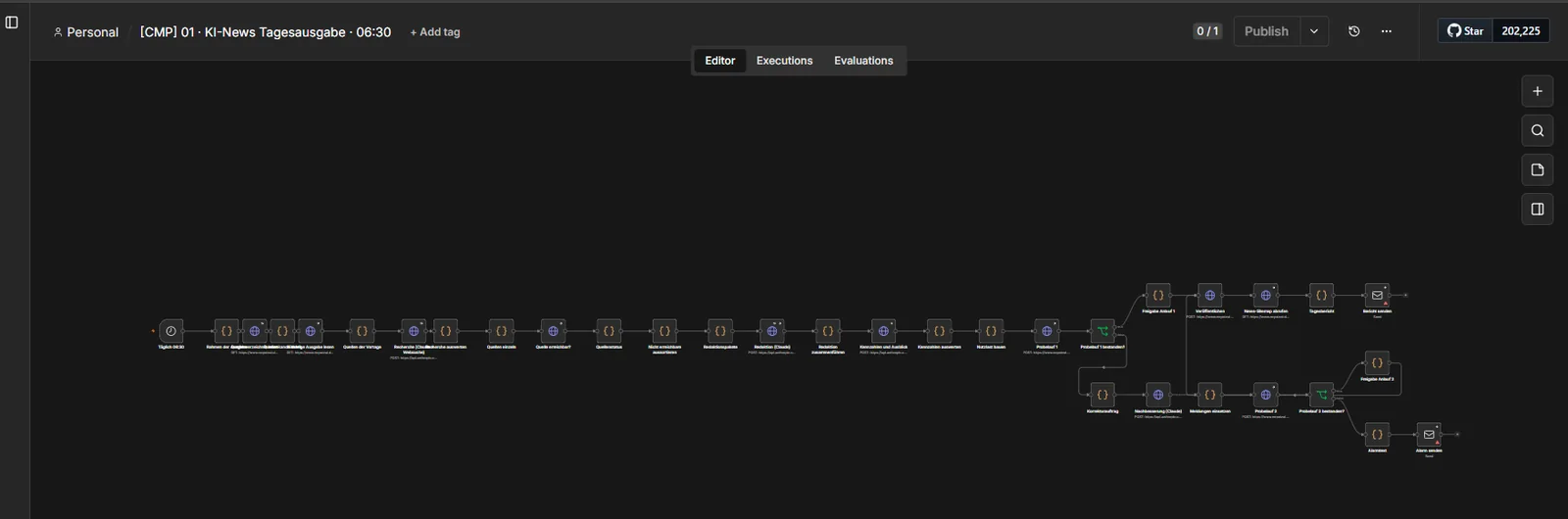
The run consists of a source sweep, an editorial pass, two review passes with a correction loop and only then publication. The decisive part is not the generation but the review: if anything looks off, an alert goes out instead of an edition. Better no piece than a wrong one.
Role filter
The same edition, sorted by perspective: what matters to the board, to IT, to marketing. A reader does not want everything, only their part.
Four language versions
Every edition appears multilingual. In an automated run that costs almost nothing and opens reach beyond the German market.
The day in numbers
A fixed element with the day's key figures. Recognisable components turn a set of stories into an edition.
Weekly newsletter
The weekly round-up comes from the same data. No second editorial process, no second version of the truth.
How it is built
The decisions behind it
Automatically produced content is a delicate subject. Whether it holds up is decided by the review steps, not by the generation.
- Two review passes rather than one. The first checks factual coherence, the second language and clarity. A single pass catches too little; three add nothing.
- When in doubt, no edition. An alert is inconvenient; a wrong story under your own name is worse. That order has to be settled before the first run, not after the first incident.
- Its own database tables, its own prefix. The paper shares a database with the other systems but its tables are clearly separated. Without that separation, applications collide by the third system at the latest.
- Development separate from the live state. The paper is built in its own folder and only moved across after review. What is live is never a work in progress.
What it means
What this is worth to a company
Not every company needs a daily paper. But almost every one has the problem behind it.
- I know where automated content holds up – and where it does not. News coverage: yes. A specialist piece with an argument of its own: no. Knowing that boundary is worth more than any tool.
- The review steps are the actual work. Anyone can have something generated today. Making sure nothing wrong appears under your own name is the job.
- Regularity beats perfection. A decent daily edition brings more visibility than four perfect pieces a year. That is a marketing insight, not a technical one.
The paper is the proof that it runs. Not because it is technically demanding, but because it appears every morning. A system that works 365 days a year without intervention says more about how it was built than any feature list.
Take it with you
This reference as a PDF
The figures, the build and the reasoning, laid out for A4 – without navigation, with contact details in the footer.