The numbers
What this website saves
The numbers first, the reasoning after. If you only have a minute, this section is it.
See the breakdown – item by item
| What a site of this size costs | Through an agency | Here |
|---|---|---|
| Concept, information architecture, design system | €8,000 – 15,000 | worked out in house |
| Design and build, 117 pages | €12,000 – 22,000 | built in house |
| Copy and SEO architecture | €5,000 – 8,000 | written in house |
| Ongoing retainer | €800 – 2,000 per month | none |
| Hosting | €50 – 200 per month | around €15 per month |
| Build once, plus the first year of upkeep | €34,600 – 69,000 | around €180 |
Where these figures come from: Typical market rates for the German Mittelstand, deliberately set at the lower end – not quotes obtained for this purpose. Anyone paying more will find the gap larger, not smaller.
The price is not the whole difference. A site you buy is finished on handover day and starts ageing from then on. A site you build yourself keeps developing, because developing it costs nothing. After twelve months that is the larger item.
Starting point
Why not a website builder
A consultancy website has to do two things at once: be found and be convincing. Website builders handle the first adequately and the second rarely.
Three reasons against the obvious answer
- Templates look like templates. Use the same builder as your competitors and you look like your competitors. For an offering that sells judgement, that is a substance problem, not a taste problem.
- Load time is not cosmetics. Builder sites carry code the page never uses. That costs visibility with Google and patience with the reader – both measurable.
- Long-tail reach needs many pages. Being found for specialist topics means a good page for each of them. With a builder the eightieth page is as laborious as the first. With your own design system it takes two hours.
So the decision was not a technical preference but a calculation: what will it cost to add the hundredth page two years from now?
In service
What was built
No theme, no page builder, no third-party extensions. One design system of a few components, from which every page is assembled.
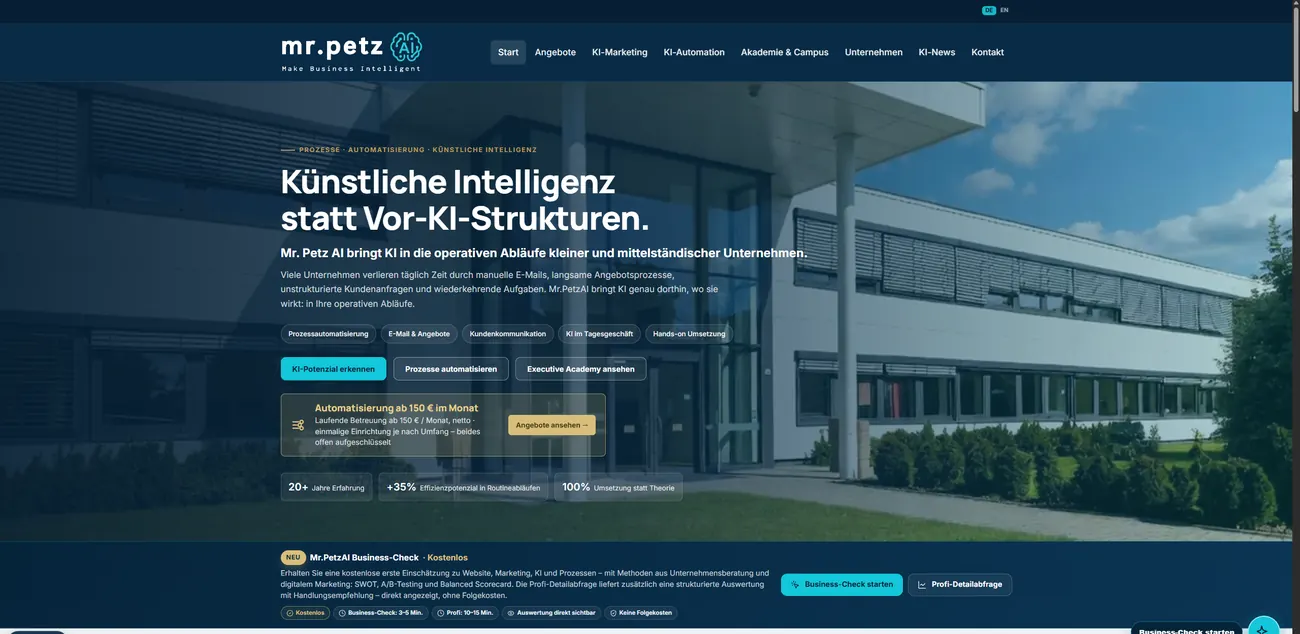
117 pages, two languages
German and English, plus service pages, specialist topics, the newspaper, the campus and the application pages. All from the same components, all in the same visual language.
A design system, not single pages
Hero, card, figure row, process chain, quote panel, form. A new page is assembled rather than designed. That is why it takes hours instead of weeks.
Long tail rather than home page SEO
Visibility comes from many good specialist pages, not from one optimised home page. Each topic gets its own page with its own search term and its own call to action.
Measured, not assumed
Load time, stability and structure are checked regularly – with the same tool the business check applies to client sites.
How it is built
The decisions behind it
A website does not live on its page count but on a handful of early decisions that cannot be corrected later.
- One stylesheet for everything. Colours, spacing, type sizes and components live in one place. Changing the button colour changes it on 117 pages at once – and cannot be forgotten on 116 of them.
- No framework, no build step. The pages are plain HTML and CSS. That sounds old-fashioned and is the reason they load fast, need no maintenance and will still work in five years.
- Images in modern formats and several sizes. A phone does not download the same image as a desktop. This is the single largest lever on load time.
- Accessibility as a requirement, not an afterthought. Keyboard operation, visible focus rings, contrast and read-aloud are built in. Not out of duty, but because decision-makers read pages on the phone and on the move.
What it means
What this is worth to a company
The website is the most visible of the seven systems – and the least telling if you only look at the surface.
- I can judge an agency quote. Having built 117 pages myself, I know what a line item called “design system implementation” means and where an estimate has been padded.
- I know what upkeep really costs. Not in hourly rates but in friction: how often does anyone change something when every change means raising a request? The answer is almost never.
- Marketing and engineering in one person. Search terms, page structure, copy and implementation belong together. Split across three people, the connection is lost in the handover.
A website is not a project, it is a working tool. It never gets finished, it gets used. Everything about this site is built on that assumption – which is why there is an editorial system beside it instead of an invoice for text corrections.
Take it with you
This reference as a PDF
The figures, the build and the reasoning, laid out for A4 – without navigation, with contact details in the footer. To pass on or to print.